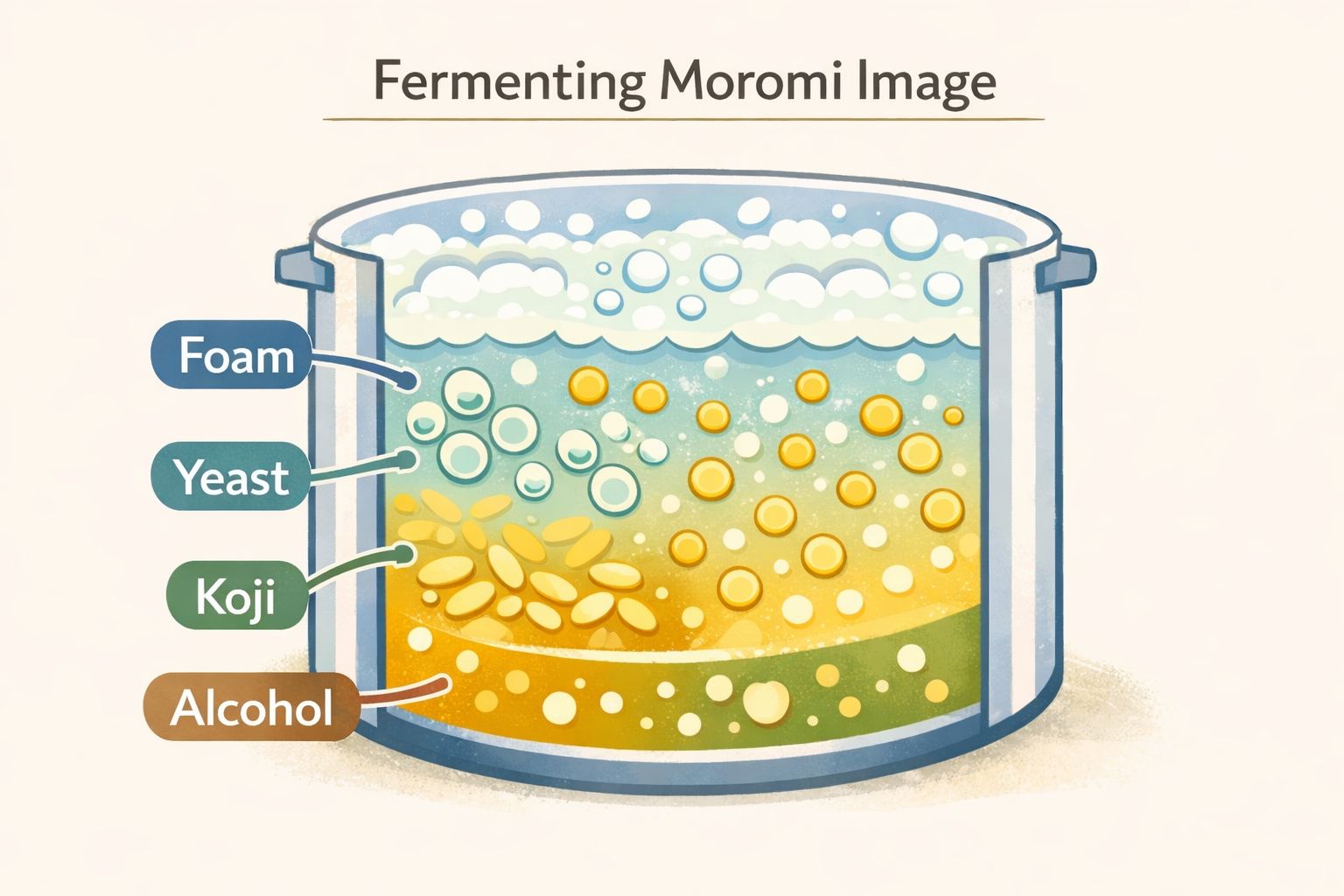
The most important thing to understand about how sake works is not memorizing the names of each step.
The key point is just one thing: the role that makes sugar (koji) and the role that makes alcohol (yeast) work at the same time. This is called parallel multiple fermentation.
If you think of sake as “a drink that produces alcohol directly from rice,” it will stay confusing.
But once you realize it’s a teamwork system—koji and yeast working side by side—the entire brewing process suddenly connects and makes sense.
- What Is Parallel Multiple Fermentation? (The Fastest Way to Understand—with a Diagram)
- Understand the Process Not by “Order,” but by “What Each Step Increases”
- 1) Rice Polishing: Reducing Components That Can Create Off-Flavors
- 2) Steaming Rice → 3) Koji Making: Building the Engine for Saccharification
- 4) Yeast Starter: A “Starter” That Grows Yeast in Advance
- 5) Multi-Stage Additions: Controlling Temperature, Contamination, and Yeast Growth
- 6) Moromi (Main Mash): The Real Stage of Parallel Multiple Fermentation
- 7) Pressing → Filtration → Pasteurization → Storage → Bottling
- The Full Process Flow
- Summary
- ▶ Next: Learn “Three-Stage Additions”
What Is Parallel Multiple Fermentation? (The Fastest Way to Understand—with a Diagram)
Here’s the shortest way to explain parallel multiple fermentation:
- Saccharification: Koji converts rice starch into sugar.
- Fermentation: Yeast turns that sugar into alcohol.
- In sake, these two processes happen at the same time.
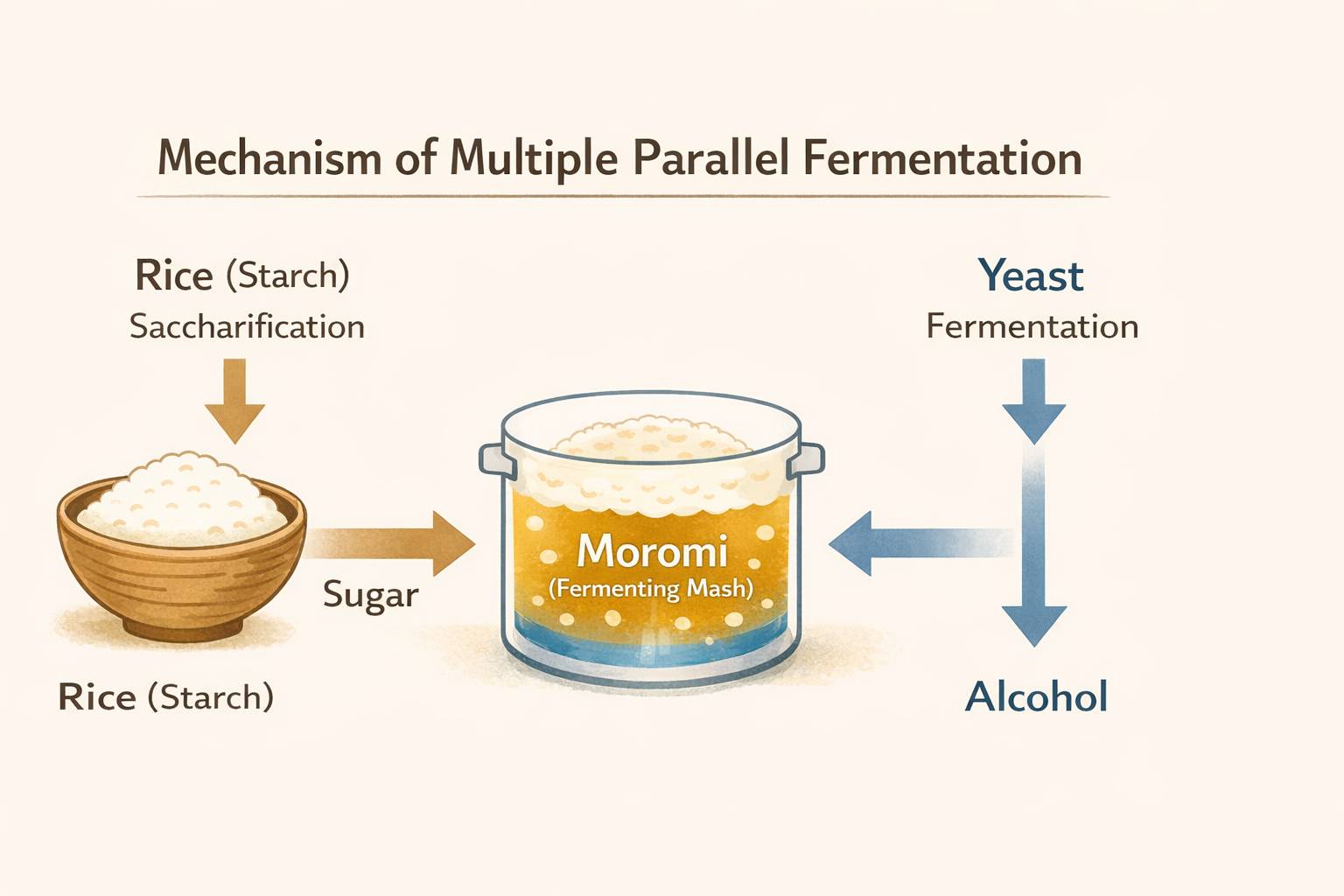
The important thing here is that “parallel multiple fermentation” is not a technical term you memorize just for the sake of memorizing.
It’s a way of thinking that helps you understand sake brewing as a whole.
Koji makes sugar, and yeast makes alcohol. If you use this “simultaneous process” as your 중심 axis, the meaning of each step starts to connect naturally—like “Why do we grow yeast first in the starter?” “Why add ingredients in stages?” and “Why stop everything with pasteurization?”
In other words, understanding parallel multiple fermentation helps you understand the brewing process with reasons, not just as a list of steps.
Understand the Process Not by “Order,” but by “What Each Step Increases”
Sake brewing has many steps, but if you only line them up in order, it becomes pure memorization.
So in this article, I’ll summarize the process from a different viewpoint: what each step is trying to increase or control.
1) Rice Polishing: Reducing Components That Can Create Off-Flavors
Rice polishing is done because the outer layers of rice contain higher amounts of compounds (such as proteins and fats) that can negatively affect aroma and taste if there’s too much. The goal is to reduce them while keeping what’s needed.
A rice polishing ratio of 60% does not mean “polish away 60%.” It means “polish away 40% and keep 60%.”
2) Steaming Rice → 3) Koji Making: Building the Engine for Saccharification
Koji making is the step responsible for saccharification—breaking starch into sugar. In sake brewing, enzymes produced by koji mold do this work. Without sugar, yeast cannot produce alcohol.
So what this stage is really doing is preparing a system that can supply “yeast-friendly” sugar continuously.
4) Yeast Starter: A “Starter” That Grows Yeast in Advance
The yeast starter (shubo) is positioned as the step where the brewery cultivates a large amount of healthy yeast to stabilize the main fermentation. Instead of trying to grow yeast “from scratch” in the main mash, yeast is grown first in a safer, controlled environment.
This idea makes it much easier to understand why the starter is necessary.
5) Multi-Stage Additions: Controlling Temperature, Contamination, and Yeast Growth
Multi-stage additions proceed in this order: first addition → “odori” (rest day) → second addition → final addition.
By adding ingredients gradually instead of all at once, the brewery can suppress unwanted microbes, let yeast grow sufficiently, and manage temperature more effectively.
6) Moromi (Main Mash): The Real Stage of Parallel Multiple Fermentation
In the moromi stage, koji, steamed rice, and water are added to the starter, and fermentation progresses.
After fermentation, the mash is pressed and separated into sake and sake lees. Then the process continues with filtration, pasteurization, and storage.
And here is the core of sake.
Inside the moromi, koji keeps producing sugar (saccharification), and yeast keeps converting that sugar into alcohol (fermentation).
This “simultaneous progress” is parallel multiple fermentation.
7) Pressing → Filtration → Pasteurization → Storage → Bottling
After fermentation, the moromi is pressed, filtered, and then—depending on the style—pasteurized and stored before being shipped.
The Full Process Flow
If the number of steps is starting to feel overwhelming, don’t worry.
Let’s整理 the full flow with one diagram.
As you look, focus on what is being prepared at each stage—and where parallel multiple fermentation is actually happening.

Summary
The core of sake brewing is surprisingly simple.
Koji turns starch into sugar (saccharification), and yeast turns that sugar into alcohol (fermentation).
The mechanism where these two happen at the same time is parallel multiple fermentation.
And all the many brewing steps exist to make parallel multiple fermentation work smoothly—and to protect the aroma, flavor, and quality of the sake that is created.
Instead of memorizing step names, start by understanding this structure.
That is the fastest way to understand sake more deeply.
▶ Next: Learn “Three-Stage Additions”
Once you understand parallel multiple fermentation, the next key topic is three-stage additions.
Why does sake add ingredients in three separate rounds? The reason is a smart, practical design to keep fermentation stable.
What Is Multi-Stage Additions? A Friendly Guide to Three-Stage Brewing and the Meaning of “Odori”
Let’s整理 the flow of three-stage brewing—and the important role of the “odori” rest day.


コメント