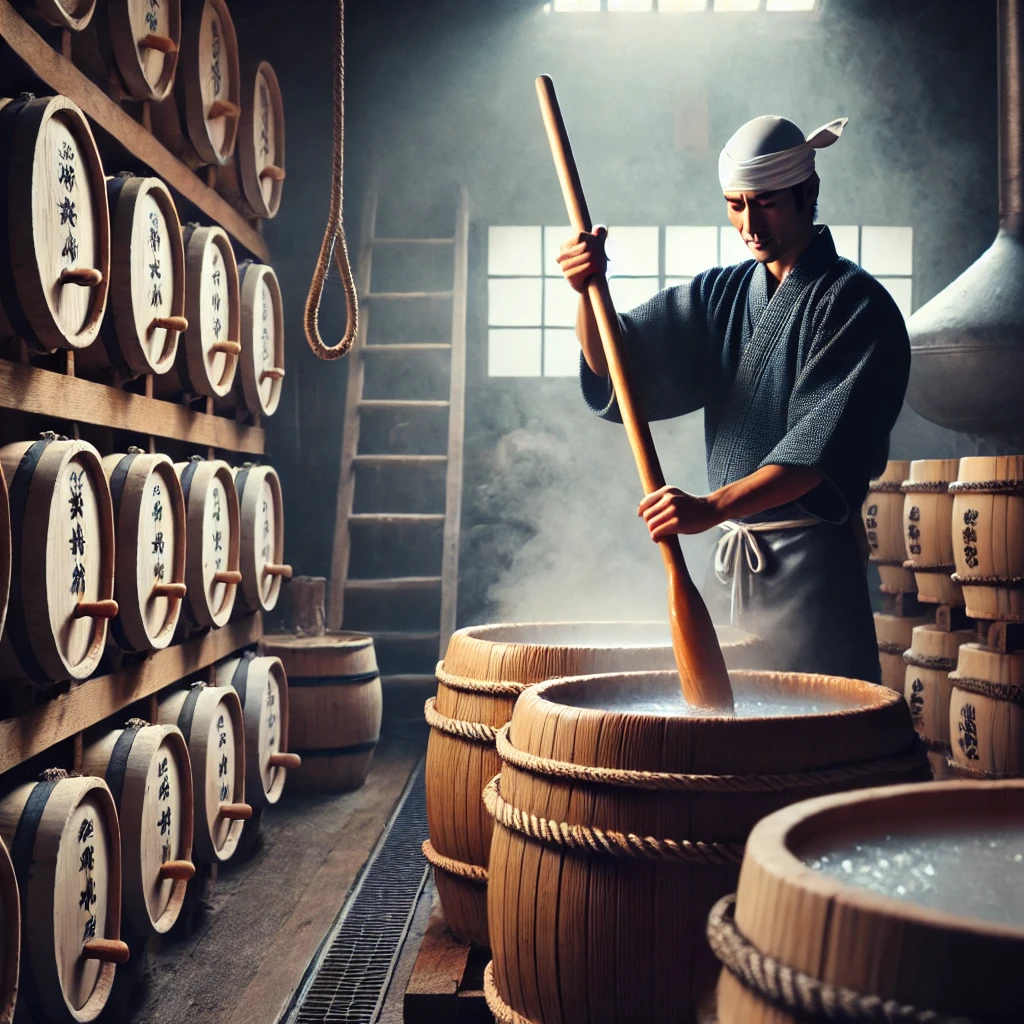
In the previous article, we organized the idea that the yeast starter, Shubo (しゅぼ, shubo), is the “starting design of fermentation.” First, yeast is increased in number, then an acidic environment is created with lactic acid to suppress unwanted bacteria, and only after that does the main fermentation begin. This is the fundamental concept behind sake brewing.
But how is that lactic acid prepared?
Here is where the three types of yeast starter differ: Kimoto (生酛, きもと, kimoto), Yamahai (山廃, やまはい, yamahai), and Sokujo (速醸, そくじょう, sokujo).
Conclusion First: The Difference Lies in How Lactic Acid Is Produced
If we summarize the difference among the three in one sentence, it is simply this: how lactic acid is prepared.
- Kimoto: Lactic acid is produced by cultivating naturally occurring lactic acid bacteria.
- Yamahai: The process is simplified, but lactic acid bacteria are still grown naturally.
- Sokujo: Lactic acid is added from the beginning.
| Item | Kimoto | Yamahai | Sokujo |
|---|---|---|---|
| Lactic Acid Preparation | Produced by natural lactic acid bacteria | Produced by natural lactic acid bacteria | Added directly |
| Yamaoroshi (山卸し, やまおろし) | Performed | Not performed | Not performed |
| Time Required | Long | Moderately long | Short |
| Stability | Difficult to control | Moderately difficult | Highly stable |
Before discussing flavor differences, it is important to understand this structure.
The core distinction is not aroma, but rather the design of fermentation.
What Is Kimoto?
Kimoto is the most traditional yeast starter method.
Its defining feature is that lactic acid is generated by naturally occurring lactic acid bacteria.
During this process, a labor-intensive step called Yamaoroshi (山卸し, やまおろし, yamaoroshi) is performed.
This involves grinding the steamed rice to create a condition in which enzymes can work more effectively.
Lactic acid bacteria are cultivated slowly over time, and only after a sufficiently acidic environment is established does the yeast begin to multiply.
As a result, it takes considerable time and effort, but it produces a robust and well-developed starter.
What Is Yamahai?
Yamahai is short for Yamaoroshi Haishi Moto (山卸し廃止酛), meaning “the yeast starter without Yamaoroshi.”
While it eliminates the Yamaoroshi step used in Kimoto, it still relies on naturally occurring lactic acid bacteria.
In other words, the method of lactic acid production is the same as Kimoto—natural generation—but the process is rationalized and simplified.
Many sake labeled “Yamahai-style brewing” today are made using this method.
What Is Sokujo?
Sokujo is a modern yeast starter method established in the Meiji era.
Its defining characteristic is that lactic acid is added at the beginning.
Rather than cultivating lactic acid bacteria naturally, an acidic environment is created immediately, allowing a stable starter to be developed in a shorter period.
Most sake in circulation today uses the Sokujo method.
Because of its efficiency and stability, it has become the mainstream approach.
Why Do These Three Methods Exist?
This raises a natural question: why are there three different methods?
The answer lies in the history of technological evolution and rationalization.
Kimoto was a traditional technique perfected through accumulated experience and time.
Later, it was discovered that the Yamaoroshi step was not strictly necessary, leading to the development of Yamahai.
Eventually, the idea of directly adding lactic acid emerged, resulting in the establishment of Sokujo.
These three are not competing methods; rather, they stand along a continuous line of fermentation technology development.
Why Do Flavor Differences Arise?
The differences in flavor do not come directly from the method itself, but from differences in the fermentation environment.
In Kimoto and Yamahai, where natural lactic acid bacteria are involved, the types and activity of microorganisms participating in fermentation vary.
In contrast, Sokujo fermentation proceeds in a more controlled and stable environment.
However, flavor is not determined by the yeast starter alone.
Rice, koji, yeast strain, and fermentation management all interact to shape the final character of the sake.
Summary
The difference between Kimoto, Yamahai, and Sokujo lies in how lactic acid is prepared.
- Kimoto: Lactic acid is produced by natural lactic acid bacteria.
- Yamahai: Yamaoroshi is omitted, but natural lactic acid bacteria are still used.
- Sokujo: Lactic acid is added directly.
This is not a matter of superiority or inferiority, but a difference in fermentation design.
Viewing it from this perspective makes the rational structure of sake brewing much clearer.
The yeast starter was born from confronting the risk of fermentation failure.
But why did it become necessary in the first place—and how did it eventually become possible to simplify or omit parts of it?
In the next article, we will explore this question in Why Was the Yeast Starter Created, and Why Was It Simplified?, tracing the rationalization and evolution of sake brewing.
コメント