In the articles so far, we’ve clarified that the heart of sake brewing lies in parallel multiple fermentation.
Kōji makes sugars, and yeast makes alcohol. That simultaneous process is the core of how sake is made.
And in dan-jikomi (staged additions), we saw how brewers increase the batch size while keeping yeast in a dominant position, so fermentation stays stable.
But where does that “yeast” come from in the first place—and how do brewers increase it reliably?
This is where shubo (the yeast starter) comes in.
What Is Shubo?
Shubo is the step where brewers grow a large amount of yeast before preparing the main mash (moromi).
It is also called moto (starter).
Its purpose is very clear:
to give yeast the advantage so fermentation can start safely and predictably.
Shubo is not just “preparation.” It is fermentation design itself.
You can think of it as the “start-up design” that strongly affects whether fermentation succeeds or fails.
Why Is Shubo Necessary?
Fermentation doesn’t happen in a world where only yeast exists.
Rice, water, and even the air contain many kinds of microorganisms.
If you start a large batch while yeast is still scarce, unwanted bacteria can multiply first.
That makes fermentation unstable, and quality becomes difficult to maintain.
So in sake brewing, before moving into the main fermentation (moromi), brewers choose a simple strategy:
increase the yeast population first.
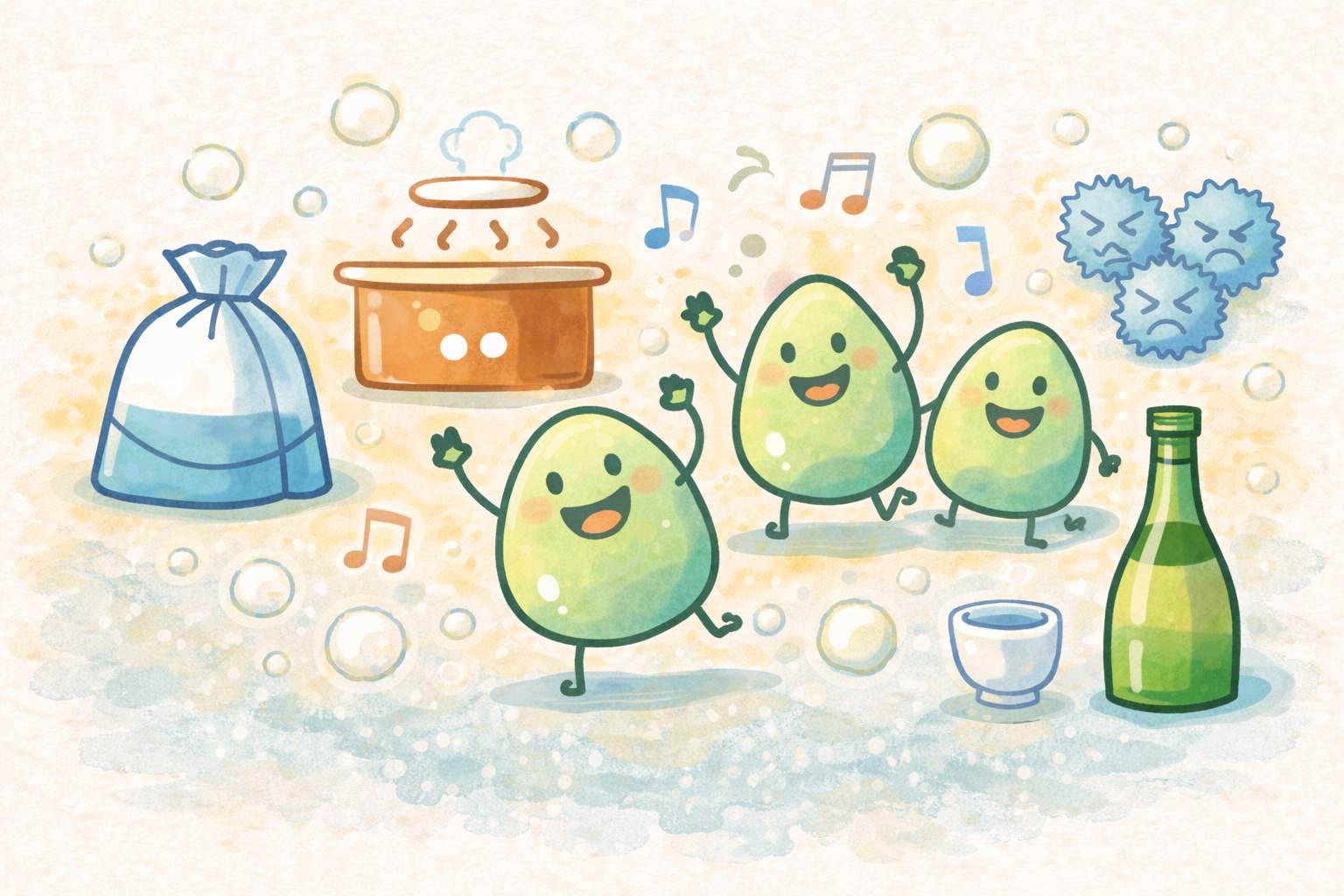
In a microbial “territory battle,” shubo is the step that puts yeast in the winning position.
Shubo Was Born From a History of Failure
Today shubo feels like an obvious step—but it wasn’t always this way.
In the past, spoilage caused by unwanted microbes was common, and sake brewing was far less reliable.
Through repeated trial and error, brewers established the method of “grow yeast first, create an acidic environment, then move into the main mash.”
Shubo is practical wisdom—developed over time—to protect fermentation.
What Happens Inside Shubo?
| Item | What happens | Purpose |
|---|---|---|
| Yeast growth | Yeast multiplies to a high level | Start fermentation in a dominant position |
| Lactic acid production / addition | The environment becomes acidic | Suppress unwanted microbes |
| pH decrease | The acidic condition stabilizes | Creates an advantage for yeast |
| Small alcohol production | Fermentation begins | Prepare for the transition to moromi |
Several important changes happen inside the starter.
- Yeast multiplies
- Lactic acid is produced (or added)
- pH drops (the environment becomes acidic)
- A small amount of alcohol is produced
The key point is creating an acidic environment with lactic acid.
When lactic acid lowers the pH, many unwanted bacteria struggle to grow.
Yeast, on the other hand, is relatively tolerant of acidity—so it can multiply more successfully.
In other words, shubo is a system that does two things at once: it “grows yeast” and it “suppresses everything else.”
Shubo Duration and Temperature
Shubo is typically cultivated over about 2 to 4 weeks.
It is usually managed at low temperatures around 10°C.
Slow growth at low temperature helps keep yeast healthy while limiting the growth of unwanted microbes.
Here again, you can see the consistent design idea: “keep yeast dominant.”
Understanding the Role of Lactic Acid One Step Deeper
When people explain shubo, the word “lactic acid” always appears.
So why is it so important?
The biggest role of lactic acid is to make the environment acidic.
Many unwanted bacteria prefer conditions close to neutral pH, and they struggle under acidic conditions.
Sake yeast, however, is relatively acid-tolerant.
So lactic acid acts like a tuning device that creates “a battlefield where yeast can win.”
The important takeaway is this: shubo is not only a place to increase yeast numbers—it is also a place to design the conditions for successful fermentation.
Temperature control, the presence of lactic acid, and adjustments to water content—
these factors work together so that parallel multiple fermentation in the main mash can proceed smoothly.
Shubo doesn’t merely increase the “quantity” of yeast. It prepares the “conditions” of fermentation itself.
Shubo Is the Blueprint for Fermentation
Parallel multiple fermentation in moromi is the core of sake brewing.
But whether that core process runs stably depends heavily on the quality of the yeast starter.
A sufficient yeast population.
A well-established acidic environment.
Unwanted microbes kept under control.
Only when these conditions are in place can brewers expand the batch through staged additions without breaking fermentation stability.
What Happens If the Starter Is Weak?
If yeast hasn’t multiplied enough in shubo, parallel multiple fermentation after moving into moromi can become unstable.
Sugars are being supplied, but there aren’t enough yeast cells to process them.
Fermentation slows down—and that gap creates room for unwanted microbes to enter.
In that sense, shubo is like a safety device designed to make parallel multiple fermentation succeed.
Summary
Shubo is the starting point of fermentation in sake brewing.
- Grow a large amount of yeast
- Create an acidic environment with lactic acid
- Suppress unwanted microbes
- Build a safe foundation for fermentation
Sake brewing is designed not only around “how fermentation proceeds,” but also around “how fermentation begins.”
That is one of the clearest examples of the rational logic behind sake making.
Next time, we’ll organize how brewers prepare lactic acid—
by comparing kimoto, yamahai, and sokujo.

コメント