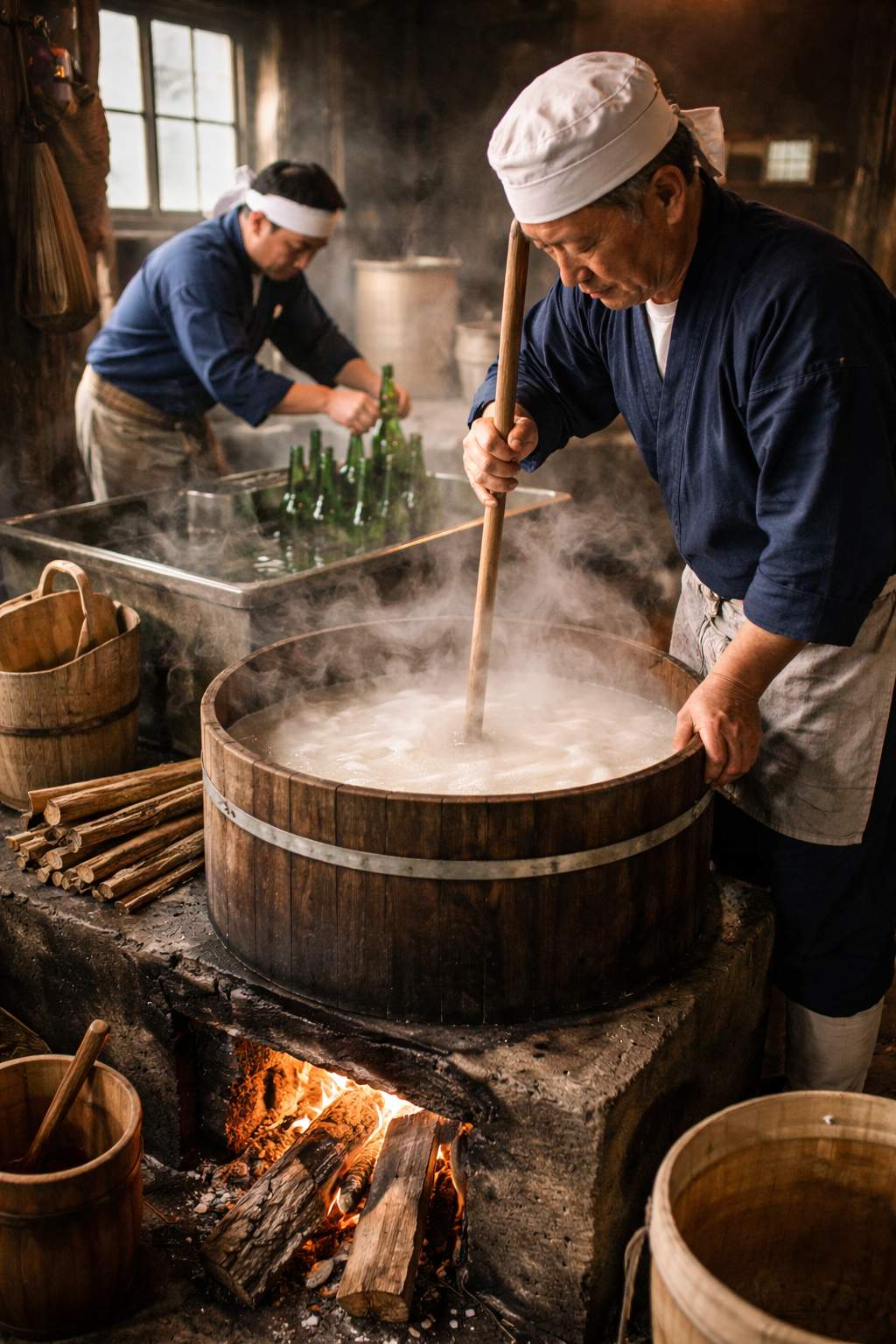
In the sake section, you often see the words 「原酒(げんしゅ / genshu)」「生酒(なまざけ / namazake)」「生貯蔵酒(なまちょぞうしゅ / namachozō-shu)」.
You may have a rough image like “genshu is strong” or “namazake is fresh,” but can you explain the differences clearly?
In fact, these three become very simple once you narrow the organizing axes down to two.
- Whether it is 火入れ(ひいれ / hiire) – pasteurized – or not
- Whether it is 加水(かすい / kasui) – diluted with water – or not
Using these two as your 기준, even confusing label terms become easy to understand.
- What Is Genshu? — The Key Point Is “No Dilution”
- What Is Namazake? — No Pasteurization at All
- What Is Namachozō-shu? — Not Pasteurized During Storage
- Visual Guide: Identify Pasteurization by “Count” and “Timing”
- Organize with Two Axes (One Table Does It)
- Differences in Typical Flavor Tendencies
- Storage Tips
- Why Are These Easy to Mix Up?
- Summary
- Next Theme: “Storage and Temperature”
What Is Genshu? — The Key Point Is “No Dilution”
Let’s start with genshu.
Genshu is sake that is not diluted with water after pressing.
Normally, right after fermentation and pressing, sake often ends up at around 17–20% alcohol.
Because that can feel a bit strong, many brewers adjust it to around 15% by adding water at the finishing stage.
Genshu does not do this dilution.
As a result, it tends to have these characteristics:
- Higher alcohol content (often around 17–20%)
- A richer, more concentrated taste
- A stronger sense of body
Here is the important point: genshu is not defined by whether it is pasteurized.
There is genshu that is pasteurized, and there is also 生原酒(なまげんしゅ / nama-genshu), which is not pasteurized.
So “genshu” is a dilution category, not a pasteurization category.
If you mix these up, the whole picture becomes vague very quickly.
What Is Namazake? — No Pasteurization at All
Next is namazake.
Namazake is sake that has not been pasteurized even once.
Hiire is a heating step (about 60–65°C) and its main purposes are:
- Stopping enzyme activity
- Suppressing microbial activity
- Stabilizing quality
Typically, sake is pasteurized twice: once before storage and once before shipping.
Namazake skips both.
As a result, it often shows characteristics such as:
- Fresh, youthful aromas
- A light sense of natural carbonation in some cases
- A sharper overall impression
However, because it is not pasteurized, it is sensitive to temperature changes, so refrigeration is basically required.
You could say namazake is a sake that carries “delicacy” in exchange for “freshness.”
What Is Namachozō-shu? — Not Pasteurized During Storage
The most confusing term is often namachozō-shu.
Namachozō-shu is sake that is not pasteurized during storage, and is pasteurized only once, just before shipping.
Typical sake is pasteurized twice:
- 1st: before storage
- 2nd: before shipping
Namachozō-shu follows this style:
- Before storage: no pasteurization
- Before shipping: pasteurization
Because of this, it is not as delicate as namazake, but it tends to keep more freshness than fully pasteurized sake.
Its flavor often leans toward:
- Light
- Clean
- Refreshing
Visual Guide: Identify Pasteurization by “Count” and “Timing”
With hiire, it’s not only “yes/no”—when it happens also matters.
In the diagram below, check where pasteurization occurs: before storage, and/or before shipping.
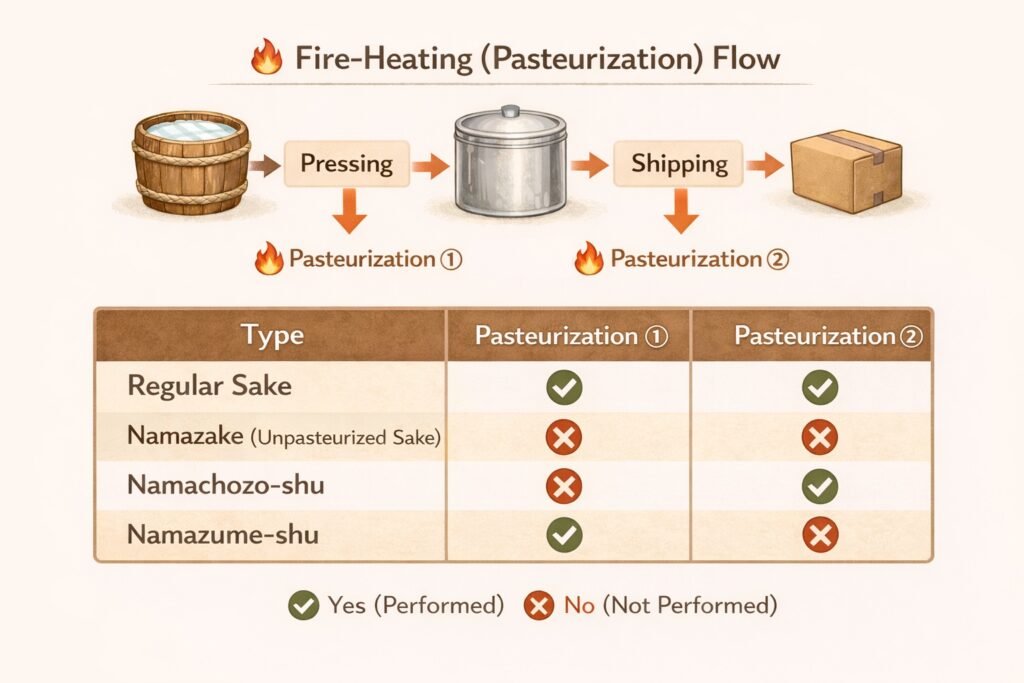
Note: 生詰酒(なまづめしゅ / namazume-shu) is the type that is pasteurized before storage, but not pasteurized before shipping.
Its timing is the reverse of namachozō-shu, so learning them together helps prevent confusion.
Organize with Two Axes (One Table Does It)
If we put everything into a table using the two axes—“hiire” × “kasui”—the relationships become clear at once.
| With dilution | No dilution (Genshu) | |
|---|---|---|
| Pasteurized twice | Regular sake | Pasteurized genshu |
| Pasteurized once | Namachozō-shu | Namachozō genshu |
| Pasteurized zero times | Namazake | Nama-genshu |
So the core relationships are:
Genshu = no dilution
Namazake = no pasteurization
Namachozō-shu = no pasteurization during storage (pasteurized once before shipping)
And the reason the word “nama-genshu” exists is that it satisfies both conditions:
“not pasteurized” + “not diluted.”
These words combine because they describe different axes.
Differences in Typical Flavor Tendencies
Of course, the actual character depends on the brand, but as general tendencies:
- Genshu: rich and powerful
- Namazake: fresh and lively
- Namachozō-shu: light, clean, and balanced
Still, these are only trends. Impressions change greatly depending on brewing method, yeast, rice variety, and polishing ratio.
These label terms are basically process information.
But it is also true that the process is an important factor that shapes the direction of the flavor.
Storage Tips
Understanding the label terms is also important for choosing the right storage method.
- Namazake: always refrigerate (weak against temperature changes)
- Namachozō-shu: refrigeration recommended (at minimum cool and dark; ideally refrigerated)
- Genshu: relatively stable, but avoid high temperatures (cool and dark to refrigerated is best)
Especially for namazake, temperature control directly affects quality. This is a key point to understand, including how to handle it at home.
Why Are These Easy to Mix Up?
The confusion often happens because “genshu” and “namazake” can sound like they have similar images.
Both can feel like “as-is” or “fresh.”
But in reality, they are defined by completely different criteria:
- Genshu means “no water added”
- Namazake means “no pasteurization”
Because the criteria are different, the words can combine.
Summary
We have organized the label terms “genshu,” “namazake,” “namachozō-shu,” and “namazume-shu.”
Even terms that look difficult become simple if you separate them into two axes.
- Genshu = no dilution
- Namazake = no pasteurization
- Namachozō-shu = not pasteurized during storage (pasteurized once before shipping)
- Namazume-shu = pasteurized before storage, not pasteurized before shipping
These labels are not “names of flavors.” They are information about the process.
But it is also true that the process shapes the direction of the taste.
Once you know the differences in brewing steps, you start to see labels differently.
And choosing sake becomes a lot more fun.
Next Theme: “Storage and Temperature”
Now you understand “how it was made.”
Next, what matters is how to handle it.
Why does namazake require refrigeration?
How far can pasteurized sake safely stay at room temperature?
And how does temperature change the taste?
Sake changes its expression greatly depending on storage and temperature.
In the next category, we will organize the science of storage and temperature ranges (chilled, room temperature, and warm).
Now that you understand the labels, the discussion of storage and temperature should feel much more three-dimensional.
コメント