When studying sake rice, you will repeatedly encounter the term 心白(しんぱく / shinpaku).
At the same time, you may also hear comments like these.
“Isn’t shinpaku a defect because it cracks easily?”
“Doesn’t the white cloudiness indicate immaturity?”
Indeed, according to the evaluation standards for table rice, shinpaku is not necessarily a welcome characteristic.
So, is shinpaku truly a “defect”?
In this article, we will examine shinpaku from a structural perspective and consider its rationality.
- Why Shinpaku Is Sometimes Called a “Defect”
- However, the Evaluation Reverses in Sake Brewing
- Understanding Shinpaku Structurally
- The Relationship Between Shinpaku and Broken-Grain Ratio Is Not Simple
- Defect or Optimization?
- Sake Rice Reflects a Different Design Philosophy
- Conclusion: Evaluation Depends on Purpose
Why Shinpaku Is Sometimes Called a “Defect”
First, let us clarify why shinpaku is sometimes regarded as a defect.
| Evaluation Axis | Standard for Table Rice | Assessment of Shinpaku |
|---|---|---|
| Whole grain ratio | Higher is better | Concern about cracking |
| Visual uniformity | Clear and uniform appearance preferred | White opacity seen as negative |
| Strength | Physical strength is important | Tends to be slightly lower |
In other words, it is considered a “defect” within the evaluation framework of table rice.
The shinpaku area has lower starch density and a somewhat coarse structure. As a result, its physical strength is slightly reduced, making it more prone to cracking under impact.
During the polishing process known as 精米(せいまい / seimai) – rice polishing – broken grains called 砕米(さいまい / saimai) may occur. A high broken-grain ratio reduces yield. Since table rice prioritizes appearance and whole-grain percentage, the presence of shinpaku can become a negative factor.
Additionally, because it appears cloudy white, its visual uniformity is sometimes judged unfavorably.
Thus, it is regarded as a “defect” only within the evaluation criteria for table rice.
However, the Evaluation Reverses in Sake Brewing
In the context of sake brewing, however, the situation changes.
In sake production, rice is steamed, mold is cultivated, and enzymes break starch down into sugars. Yeast then uses those sugars to produce alcohol.
This mechanism, known as 並行複発酵(へいこうふくはっこう / heikō fuku hakkō) – multiple parallel fermentation – depends critically on whether mold can penetrate into the interior of the rice grain.
Because the starch arrangement in the shinpaku region is relatively loose, fungal hyphae can enter more easily, and enzymes can act more effectively within the grain.
In other words, a structural feature that may be a weakness for table rice functions as an advantage in brewing.
When the evaluation criteria change, the meaning changes as well.
Understanding Shinpaku Structurally
To understand shinpaku, we must look at starch structure.
Rice starch consists of amylose and amylopectin. Normally, these form highly crystalline structures packed relatively densely.
In the shinpaku region, however, starch granules are arranged more irregularly and contain numerous microscopic gaps. This difference in density scatters light, causing the area to appear opaque.
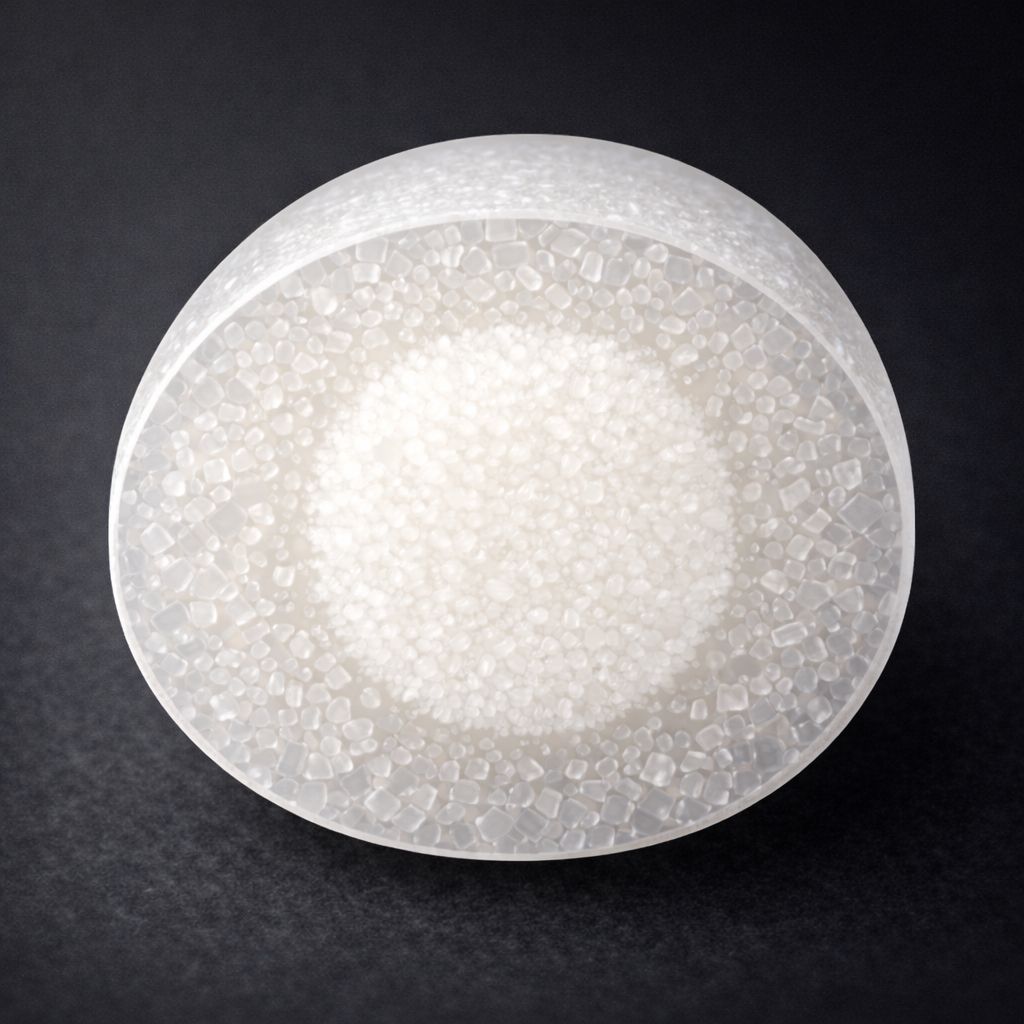
The important point is that this is not a “hole.”
Shinpaku is not a cavity; it is more accurate to describe it as a “low-density starch region.”
This structural difference influences water absorption, steaming behavior, and the ability of 麹菌(こうじきん / kōjikin) – koji mold – to penetrate the grain.
The Relationship Between Shinpaku and Broken-Grain Ratio Is Not Simple
It is not as simple as saying that larger shinpaku always leads to easier cracking.
The broken-grain ratio is influenced not only by shinpaku size but also by overall structural balance, outer-layer strength, and polishing conditions.
Factors Affecting Broken-Grain Ratio
| Factor | Influence |
|---|---|
| Shinpaku size | Only one element |
| Grain size | Larger grains are more stable |
| Outer-layer strength | Important |
| Polishing conditions | Significant impact |
山田錦(やまだにしき / Yamada Nishiki), a representative sake rice variety, has a large shinpaku yet remains relatively stable. This is because the grain itself is large and structurally well-balanced.
In other words, the existence of shinpaku itself is not a defect; balance within the overall design is what matters.
Defect or Optimization?
Let us shift perspective.
In industrial materials, evaluation is based on suitability for purpose. Even a material with lower strength can be excellent if lightness or workability is required.
The same applies to sake rice.
Table rice emphasizes taste and visual perfection.
Sake rice emphasizes brewing functionality.
When the evaluation axis changes, a “defect” becomes a “function.”
Shinpaku is not an accidental flaw but a structural characteristic adapted to the purpose of brewing.
Sake Rice Reflects a Different Design Philosophy
Breeding sake rice is not simply about producing large grains.
Stability of shinpaku, protein content, broken-grain ratio, water absorption behavior—these factors are comprehensively adjusted to achieve brewing suitability.
Varieties such as 山田錦(やまだにしき / Yamada Nishiki), 五百万石(ごひゃくまんごく / Gohyakumangoku), and 美山錦(みやまにしき / Miyama Nishiki) have each been improved under distinct design philosophies.
Shinpaku symbolizes that design philosophy.
Conclusion: Evaluation Depends on Purpose
Shinpaku is not a cavity.
It is a functional low-density region created by differences in starch structure.
While it may be a weakness under table-rice standards, it plays a crucial role in sake brewing.
Whether something is a defect is not absolute.
It depends on the intended purpose.
When we look inside a single grain of rice, we begin to see how rationally designed the culture of sake truly is.
Shinpaku is not a defect—it is a structural foundation supporting the system of sake.
▶ Next: Who Is the Main Actor in Fermentation?
Even if the structure of sake rice is well prepared, sake cannot be created by rice alone.
The entity that converts sugar into alcohol—that is 酵母(こうぼ / kōbo), yeast.
Among them, 協会酵母(きょうかいこうぼ / Kyōkai kōbo) – Association yeast strains – have played a major role in stabilizing sake quality.
How do differences in yeast influence aroma and flavor?
コメント