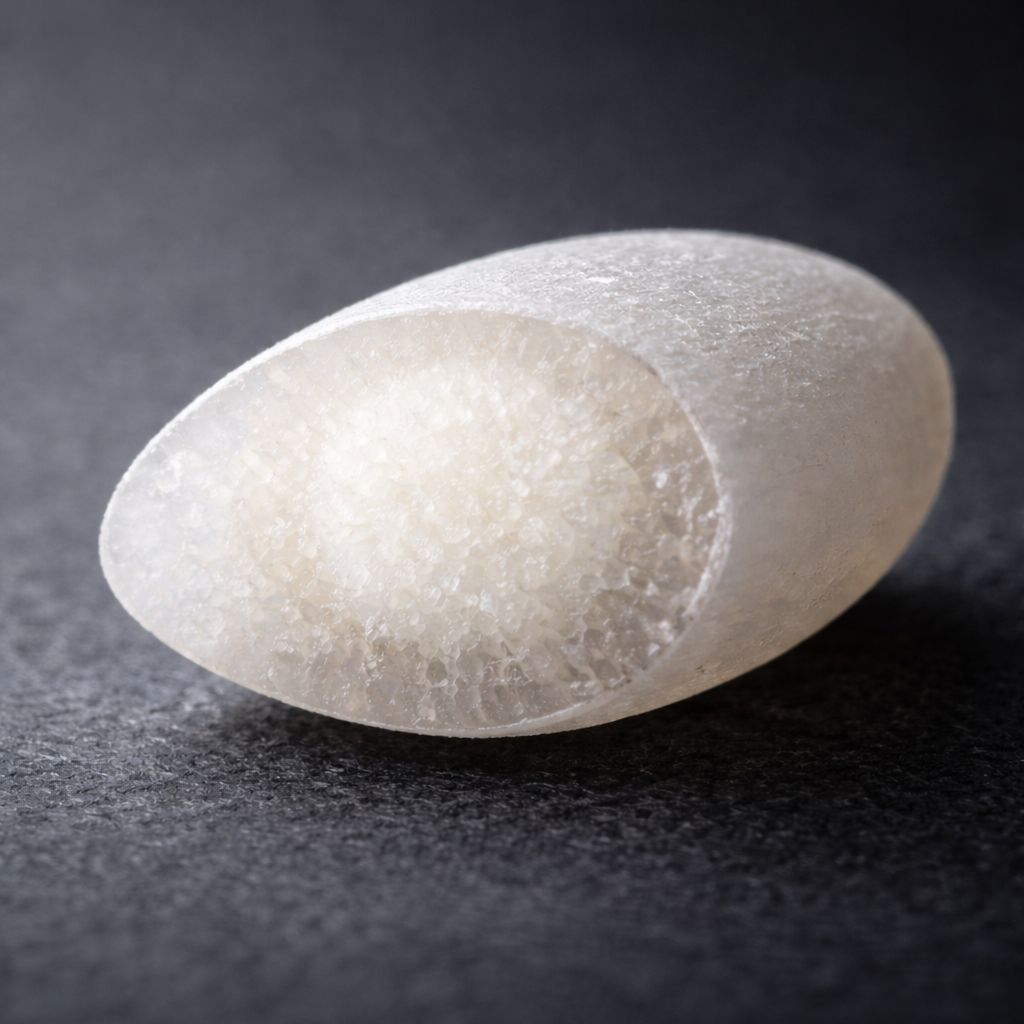
If you study sake, one term always appears: Shinpaku (心白, shinpaku).
Shinpaku refers to the opaque white core that appears near the center of a rice grain. It is often explained as “a white hollow in the middle,” but that description is not technically accurate.
So what exactly is shinpaku? And why is it so important in sake brewing?
Shinpaku Is Not a “Hole” — The True Structure
The first important point is that shinpaku is not a cavity.
The main component of rice is starch, which consists of two molecules: amylose and amylopectin. Normally, these form a relatively dense internal structure.
However, in the shinpaku region, the arrangement of starch granules is slightly coarser, with many microscopic gaps. Light scatters irregularly in this area, making it appear opaque white.
| Item | Normal Area | Shinpaku Area |
|---|---|---|
| Starch Density | High (dense) | Slightly lower (coarse) |
| Light Transmission | Relatively transparent | Light scatters; appears white |
| Structure | Uniform | Many microscopic gaps |
In other words, shinpaku is not empty space, but a difference in starch density and structure.
Comparing Sake Rice and Table Rice
Sakamai (酒米, sakamai), or sake-brewing rice, is designed with a different purpose from rice intended for eating.
| Comparison | Sake Rice | Table Rice |
|---|---|---|
| Grain Size | Large | Medium |
| Shinpaku | Likely to develop | Rare / unstable |
| Protein Content | Low | Slightly higher |
| Priority Trait | Solubility & Koji penetration | Stickiness & sweetness |
| Purpose | Brewing | Eating |
Sake rice is not designed to be delicious when eaten. It is designed to ferment efficiently.
Why Shinpaku Is Ideal for Sake Brewing
The structure of shinpaku directly supports the fermentation process of sake.
| Process | Role of Shinpaku |
|---|---|
| Washing & Soaking | Water penetrates easily to the core |
| Steaming | Heat transfers evenly to the center |
| Koji Making | Koji mold can extend hyphae into the grain |
| Saccharification | Enzymes reach the inner starch |
The most critical stage is Koji-making (Seigiku, 製麹, seigiku).
Koji (麹, koji) mold produces enzymes that break down starch into sugar. Yeast then uses this sugar to produce alcohol.
Sake’s unique fermentation system, Parallel Multiple Fermentation (並行複発酵, heiko fukuhakko), allows saccharification and alcoholic fermentation to occur simultaneously.
Shinpaku functions as a structural foundation that allows enzymes to act deep within the grain.
Types and Stability of Shinpaku
Shinpaku appears in several patterns:
- Central type
- Linear type
- Off-center type
- No shinpaku
Yamada Nishiki (山田錦), one of the most famous sake rice varieties, is known for its large grains and stable central-type shinpaku.
However, shinpaku development depends not only on the variety, but also on cultivation conditions such as temperature, sunlight, and water management.
This means that sake rice quality is closely connected to agricultural technique.
Polishing Ratio and Shinpaku
A common question is: “If the rice is highly polished, won’t the shinpaku be removed?”
In practice, polishing mainly removes the outer layers rich in protein and lipids. Since shinpaku is located near the center, a significant portion remains.
| Part | Main Components | Impact on Flavor |
|---|---|---|
| Outer Layer | Protein & Lipids | Can cause off-flavors |
| Core | Pure starch | Cleaner, more transparent taste |
This structural separation explains why lower polishing ratios tend to produce clearer flavors.
Is Shinpaku a Defect or a Function?
In table rice, shinpaku can increase the risk of cracking and is not always desirable.
In sake brewing, however, it is highly valuable.
The same structure can be judged differently depending on its purpose.
Shinpaku is not an accidental defect. From the perspective of brewing suitability, it is a functional structural feature.
Conclusion: Shinpaku as the Structural Foundation of Sake
Shinpaku is not a hollow space. It is a lower-density region formed by differences in starch structure.
This structure supports the activity of koji mold and enables sake’s distinctive fermentation system.
Understanding the internal structure of a single grain of rice leads directly to understanding how sake works.
Shinpaku is not merely a visual characteristic—it is a scientific foundation that supports sake culture.
▶ Next: Comparing Major Sake Rice Varieties
Now that we understand the structure of shinpaku, let’s examine actual sake rice varieties.
Each variety has its own characteristics—grain size, shinpaku stability, solubility, and flavor impact.
We will compare the three major sake rice varieties—Yamada Nishiki, Gohyakumangoku, and Miyama Nishiki—and explore their design philosophies.
▶ What Are the Differences Between Yamada Nishiki, Gohyakumangoku, and Miyama Nishiki?

コメント