Read a sake label or a brewery’s profile and you’ll run into phrases like “yon-gō bottle,” “isshō bottle,” or “a brewery producing several thousand koku a year.”
Alongside the milliliters and liters we use every day, sake still runs on an older unit system: gō, shō, to, and koku — a set of traditional volume measurements that predate the metric system in Japan.
These units come up constantly once you start reading labels or brewery descriptions closely. The good news: there’s no real math involved. Once you see the underlying structure, it clicks into place and stays there.
The Big Picture First
Gō, shō, to, and koku are all connected by a single rule: each step up is ×10.
How Many Milliliters Are a Gō, a Yon-Gō Bottle, and an Isshō Bottle?
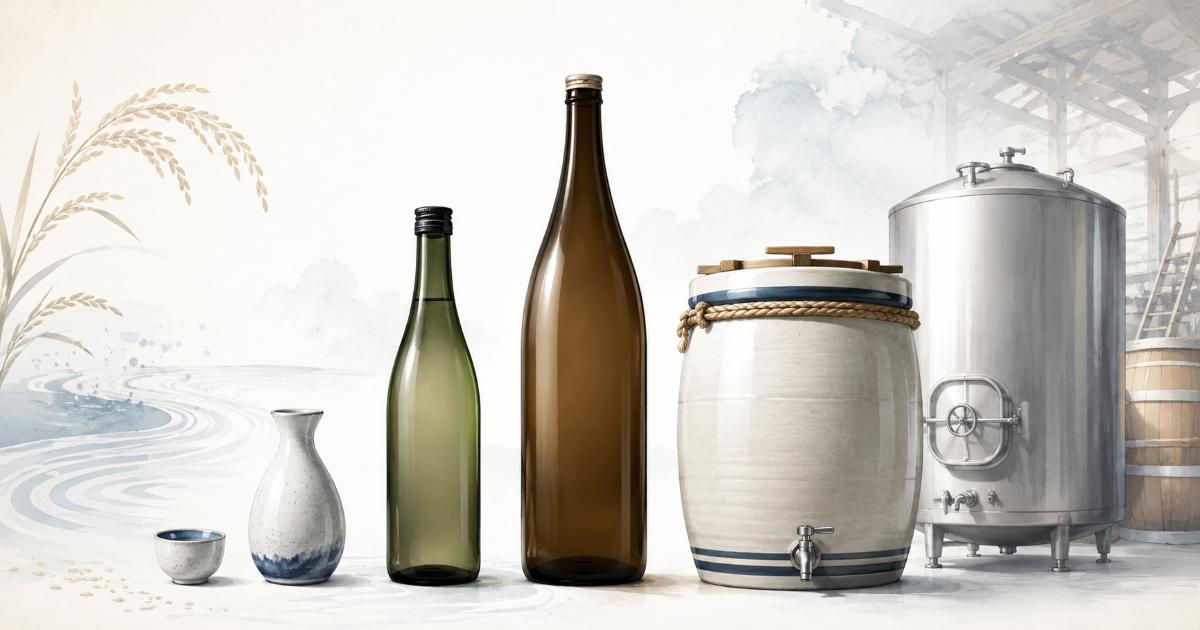
The volumes you’ll actually run into with sake: 1 gō = 180ml, a yon-gō bottle (4-gō bottle) = 720ml, and an isshō bottle (10-gō bottle) = 1,800ml.
Once these three numbers are familiar, the volumes printed on sake labels and product descriptions become much easier to read at a glance.
| Unit | Reading | In Milliliters | Relationship |
|---|---|---|---|
| 1 gō | ee-chee-goh | 180ml | base unit |
| 1 shō | ees-shoh | 1,800ml (1.8L) | 1 shō = 10 gō |
| 1 to | eet-toh | 18,000ml (18L) | 1 to = 10 shō = 100 gō |
| 1 koku | eek-koh-koo | 180,000ml (180L) | 1 koku = 10 to = 100 shō = 1,000 gō |
Each step from gō to shō to to to koku multiplies by 10. Once you anchor everything to 1 gō = 180ml, the conversions for shō, to, and koku fall into place easily.
Why Is 1 Gō Exactly 180ml?
It’s a fair question — 180 looks like an oddly specific number. The answer traces back to shakkanhō, Japan’s traditional system of weights and measures.
In shakkanhō, the starting point was actually 1 shō, defined as roughly 1,800ml. Dividing that into 10 equal parts gives you 1 gō. During the Edo period, 1 gō of rice was treated as roughly one meal’s worth. Sake inherited this system wholesale, which is why 180ml per gō is still the standard today.
Even now, long after the metric system took over daily life in Japan, “gō” remains very much alive in the world of sake. When someone orders “one gō of sake” at an izakaya, they’re using a unit of measurement that’s been in continuous use since the Edo period.
Anchoring It to Real Life
Numbers alone are easy to forget. Tying each unit to something physical makes it stick.
| Unit | Real-World Reference |
|---|---|
| 1 gō (180ml) | one tokkuri flask at an izakaya, or about 6 small sake cups |
| 1 shō (1.8L) | an isshō bottle itself |
| 4 gō (720ml) | a yon-gō bottle (the standard “small bottle” size) |
| 1 to (18L) | the unit used for commercial-scale to-bin containers and large tanks |
| 1 koku (180L) | the unit breweries use to describe their annual production volume |
The 720ml bottle commonly called a “yon-gō bottle” is exactly 40% of a 1,800ml isshō bottle. On a sake label, you’ll see “720ml” printed plainly — but behind that number is the same “4 gō = 720ml” conversion. It’s one more thing to notice next time you’re reading a label.
What Is Kokudaka? A Unit for Talking About Brewery Scale
In the sake world, “koku” is the standard unit for describing how much a brewery produces. You’ll see phrases like “a 1,000-koku brewery per year” or “one of the largest breweries in Japan, producing tens of thousands of koku.”
Since 1 koku = 180L, 1,000 koku works out to 180,000 liters — the equivalent of 100,000 isshō bottles. Put that way, it’s easier to appreciate just how large a scale “koku” is actually describing.
The term “kokudaka” originally measured rice production during the Edo period, and the economic size of each feudal domain was described the same way — as “a domain of so many thousand koku.” Sake production simply borrowed the same unit.
A small brewery typically produces under 100 koku a year; a mid-sized regional brewery might make anywhere from several hundred to a few thousand; and the largest producers can reach tens or even hundreds of thousands of koku. Once you know this, brewery profiles that mention “a X-koku brewery” suddenly carry a lot more meaning.
Quick Reference: What to Remember
These conversions come up often enough in sake conversations that three numbers are worth keeping handy.
- 1 gō = 180ml (the base figure)
- 1 shō = 10 gō = 1,800ml (the volume of an isshō bottle)
- 1 koku = 10 to = 100 shō = 1,000 gō (the unit for production volume)
Remember just one structural rule — gō, shō, to, and koku are all connected by ×10 — and you can work out everything else starting from 1 gō = 180ml. “To” rarely shows up in everyday conversation, so it’s worth pinning down separately: 1 to = 10 shō = 18L.
In Summary
Gō, shō, to, and koku form a unit system where each step is exactly 10 times the last.
- 1 gō = 180ml (an izakaya tokkuri flask)
- 1 shō = 10 gō = 1,800ml (an isshō bottle)
- 1 to = 10 shō = 18L
- 1 koku = 10 to = 100 shō = 180L (a scale of brewery production)
This unit system is already built into everyday products you’ve probably seen — the yon-gō bottle and the isshō bottle. Rather than memorizing the numbers cold, tying each one to something physical makes it far easier to recall when you actually need it.
Next Up: Storage and Temperature
By now you’ve gotten a handle on how sake is labeled and classified.
The next question worth asking is how to actually handle sake once you understand what kind it is.
Why does namazake specifically need refrigeration?
How long can pasteurized sake safely sit at room temperature?
And how does temperature actually change the way sake tastes?
Sake changes character dramatically depending on how it’s stored and served.
In the next section, we’ll dig into the science of storage and serving temperature — chilled, room temperature, and warmed sake. Now that you understand how sake is labeled, the logic behind storage and temperature should click into place just as clearly.